Really?

We need to talk. About food, real food. We need a really serious talk.

Diabetes UK has designated February as Fakeaway February. This is intended to be a fund raising event and requires a Just Giving account to sign up (althought there is no minimum sponsorship requirement). This is not my beef.

The idea is to swap out your takeaway/ready meals/convenience food throughout February for cooked from scratch, home-made versions. This is a very laudable aim and something I fully support. The benefits of not eating the over processed, over packaged offerings that constitute convenience foods are legion. You will cut your sugar intake enomously, which will have a direct impact on insulin levels. You will cut your consumption of industrial fats, avoiding all the down sides that they convey. Home made is always the best option.

No problem with home made over takeaway. Always in favour of that option.

But who, in their right mind, decided to call the campaign “Fakeaway”?

What depths has our relationship with food sunk to, that the real food version of conveience food can be proudly labeled “Fake”? There are plenty of fake foods out there, trying their best to replicate their real food forebears. The real foods they are modelled on are so good that in many cases, the fake foods have to appropriate their names in order to gain credibility.

Real food made with fresh ingredients will never be fake. It is the original version, that is so good that the food industry needed to try and replicate it in a “convenience” form. In that process, all sorts of additional ingredients and procedures were added to that original recipe. The result is the fakeaway, far removed from the real food dish that inspired the copy.

So, here’s to Real Food February. And March. Why not see if we can make it through to December and celebrate with a Real Food Christmas?
Don’t blame salt for what the sugar did…

Salt:  (also common salt)  [mass noun] A white crystalline substance which gives seawater its characteristic taste and is used for seasoning or preserving food.

Table salt – NaCl

A mineral that is so valuable to humankind that we used to pay people with it (hence your salary if you are lucky enough to be paid one).A mineral essential to the operation of the human body. It helps regulate cell size, manage electrical activity especially in the nervous system, which is fundamental to the operation of the endocrine system (hormone production). It keeps fluids in balance both in the blood and the interstitial fluid around the cells. By managing the fluid levels it helps to manage core body temperature, reducing the risk of heat stroke. It’s role in the nervous system could well be crucial to understanding migrane, fibromyalgia, neuropathy and hypersensitivity to pain.

If your salt levels are too low, you are likely to experience orthostatic hypotension when moving from sitting to standing, making you feel dizzy or faint. Low salt levels reduce your tolerance of exercise, especially in the heat.

There is no evidence that reducing salt intake reduces your risk of hypotension (1). It DOES have a role in managing blood pressure but eating salt does not raise blood pressure. Sadly, research that used very small sample sizes, coupled with overzealous interpretation and a disregard of the fundamental need for salt in the body, lead to the adoption of the salt reduction programmes with which we have all become familar.

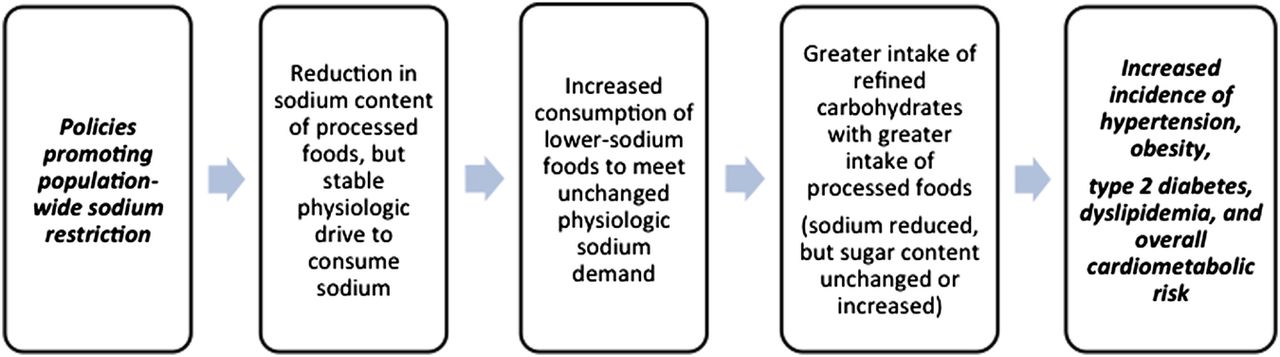
Unfortunately the law of unintended consequences kicked in and the desired result was far from achievable by the means proposed. (2)

Taking out of food one of the key minerals needed by the body for its effective operation does nothing to alter that biological need. If your body needs something, it usually has a mechanism to prompt you to seek out the required foodstuff to satisfy that need/replenish supplies. But that possible source of satisfaction has had it’s salt content reduced (because the official bodies said the manufacturers should). The population, having been told to reduce their intake, were presented with highly-processed products plastered with the comforting labels highlighting their low salt credentials.

Highly processed foods also contain high levels of added sugar and industrial oils/fats.

So, are we looking at the true culprit? Or are we punishing the wrong target?

References

  1. The Salt Fix”  Dr James di Nicolantonio Harmony Books 2017
  2. DiNicolantonio JJ, Lucan SC     The wrong white crystals: not salt but sugar as aetiological in hypertension and cardiometabolic disease